Begin with a stable material movement
Automotive plants depend on coordinated movement between warehouses, supermarkets, production areas and line-side locations. AMRs can be evaluated for selected repetitive material-flow tasks when the load, route, floor, traffic and interfaces are suitable.
The right starting question is not “Where can we place a robot?” It is “Which stable movement creates a clear operational case and can be validated safely?”
Potential automotive use cases
- Pallet movement from warehouse or supermarket areas to production
- Replenishment between defined staging and line-side locations
- Work-in-progress transfers between controlled process areas
- Return of empty pallets, containers or approved load carriers
- Movement between receiving, storage, inspection and production zones
- Repetitive internal logistics routes during defined operating windows
These are application possibilities, not claims of completed WFC customer deployments. Every workflow requires site and load verification.
Start with the load and interface
Document the pallet, container, rack or carrier; maximum weight; dimensions; fork-entry direction; stability; pickup height; delivery height; and required placement tolerance. Vehicle selection depends on the complete interface—not payload capacity alone.
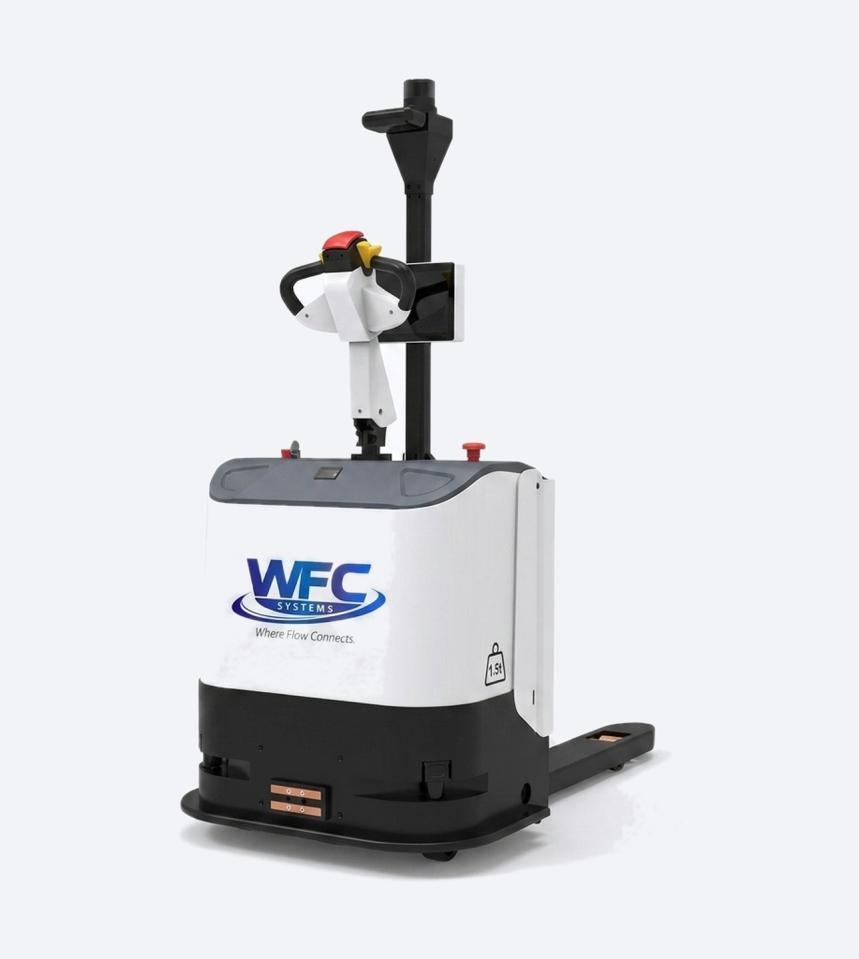
Low-level pallet transfer may point toward a pallet jack AMR category. A workflow requiring greater lift height may require evaluation of a reach truck AMR. Rack geometry, approach, clearances and the complete operating sequence must be verified.
Map the route under real conditions
Measure usable aisle width, turning space, crossings, doorways, staging areas and interaction points with the intended load included. Observe shift changes, forklift or tugger traffic, pedestrians, temporary storage, maintenance activity and peak production periods.
Evaluate production interfaces
Pickup and delivery points should be repeatable and controlled. Review how the AMR will interact with operators, pallets, racks, machines, conveyors, shutters, doors or other equipment. Identify whether each interface is manual, sensor-confirmed or system-controlled.
WMS, ERP or production-system integration requirements should be documented before scope and timing are confirmed. Supported systems and protocols must be verified for the selected solution.
Plan traffic and safety responsibilities
Identify crossings, blind corners, shared aisles, emergency routes, restricted zones and responsibility for traffic rules. The selected equipment and operating method require project-specific risk assessment, validation and training. Catalogue sensor or positioning values do not replace site-level safety planning.
Stronger project-readiness signals
- A repetitive movement with defined pickup and delivery points
- Stable pallets, loads and operating interfaces
- Clean, suitable floors and adequate route space
- A plant or operational owner with decision-making authority
- A realistic budget and implementation process
- A pilot scope with measurable acceptance criteria
- Coordination between operations, engineering, safety and IT where required
Build the business case from verified data
Record current trip frequency, travel distance, operating hours, manual interventions, waiting time and process constraints. Use measured baseline data to define what a pilot should evaluate. Avoid generic savings or return-on-investment claims that are not supported by the facility's real operating information.
A practical next step
WFC Systems can begin with an application discussion covering the load, route, lift requirement, operating schedule, traffic and intended outcome. Suitable opportunities can then progress to a site-readiness review and pilot-planning discussion.
Compare current WFC AMRs →
Use the site-readiness guide →
Plan a credible AMR pilot →