Start with a repeatable internal movement
Warehouses and logistics facilities coordinate receiving, storage, replenishment, staging, order preparation and dispatch. AMRs can be evaluated for selected repetitive movements when the load, route, interfaces, traffic and operating conditions are stable enough to support automation.
The strongest starting point is a clearly defined flow with measurable frequency, known pickup and delivery locations, and an operational owner who can validate the process.
Potential warehouse and logistics use cases
- Pallet movement from receiving or inspection to defined storage or staging areas
- Replenishment between reserve storage and forward-pick locations
- Transfer of finished goods to dispatch staging
- Movement of approved pallets or load carriers between warehouse zones
- Return of empty pallets, containers or reusable handling equipment
- Repetitive transport between a warehouse and an adjacent production area
These are application possibilities, not claims of completed WFC customer deployments. Every workflow requires site, load and interface verification.
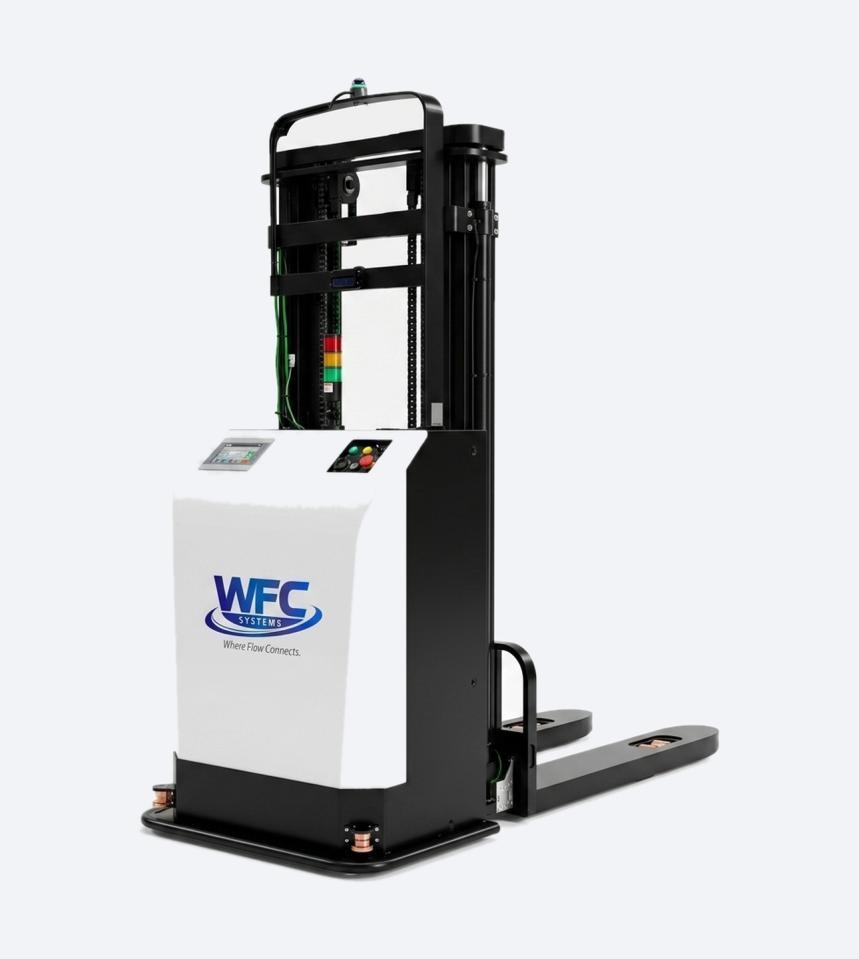
Match the vehicle to the handling interface
Document the pallet or carrier type, maximum load, dimensions, fork-entry direction, pickup height, delivery height and placement tolerance. Payload alone does not determine vehicle suitability.
Floor-level pallet transport may point toward a pallet jack AMR. Workflows involving elevated pickup or delivery may require evaluation of a reach truck AMR. The rack, pallet, approach and operating sequence must be verified together.
Measure the complete route
Review usable aisle width and turning space with the intended load included. Map doorways, crossings, blind corners, staging areas, charging access and shared traffic. Observe the route during peak operations, not only when the facility is quiet.
Clean, level flooring and disciplined storage practices are important readiness signals. Dust, debris, damaged floors, temporary obstructions and pallets extending into routes can reduce project suitability or require corrective work.
Define pickup and delivery control
Each transfer point should have a clear location, stable orientation and agreed operating procedure. Confirm how operators, racks, pallets, conveyors, doors or other equipment will signal that a pickup or delivery is ready and complete.
If WMS, ERP or warehouse-control integration is required, document the workflow, ownership, supported interfaces and exception handling before committing to scope or timing.
Plan mixed traffic and exceptions
Shared routes may include people, forklifts, pallet trucks, tuggers and temporary loads. Identify right-of-way rules, crossings, restricted areas, emergency access and responsibility for keeping routes clear. The selected equipment and operating method require project-specific risk assessment, validation and training.
Also define what happens when a pallet is missing, misaligned, damaged or unstable; a route is blocked; an interface is unavailable; or a task cannot be completed.
Stronger project-readiness signals
- High-frequency, repeatable internal transport
- Stable pallets, loads and handling interfaces
- Clean floors, organized routes and adequate clearances
- Defined pickup, delivery and exception procedures
- An operations or warehouse owner with decision-making authority
- A realistic budget, implementation process and measurable pilot scope
- Coordination between operations, engineering, safety and IT where required
Build the pilot around measurable operations
Record trip frequency, route distance, operating hours, waiting time, manual interventions and current constraints. Use this baseline to define pilot acceptance criteria such as task completion, interface reliability, route availability and agreed operational response—not generic savings claims.
A practical next step
WFC Systems can begin with an application discussion covering the load, route, lift requirement, facility conditions, traffic, systems and intended outcome. Suitable opportunities can then progress to a site-readiness review and pilot-planning discussion.
Compare current WFC AMRs →
Use the site-readiness guide →
Plan a credible AMR pilot →